

Table of Contents
The Real Stuff
Welcome to a deep dive into the essence of premium Chinese tea. If you are searching for the pinnacle of the green tea experience, your quest will inevitably lead you to a singular destination: Full Handmade Longjing Tea.
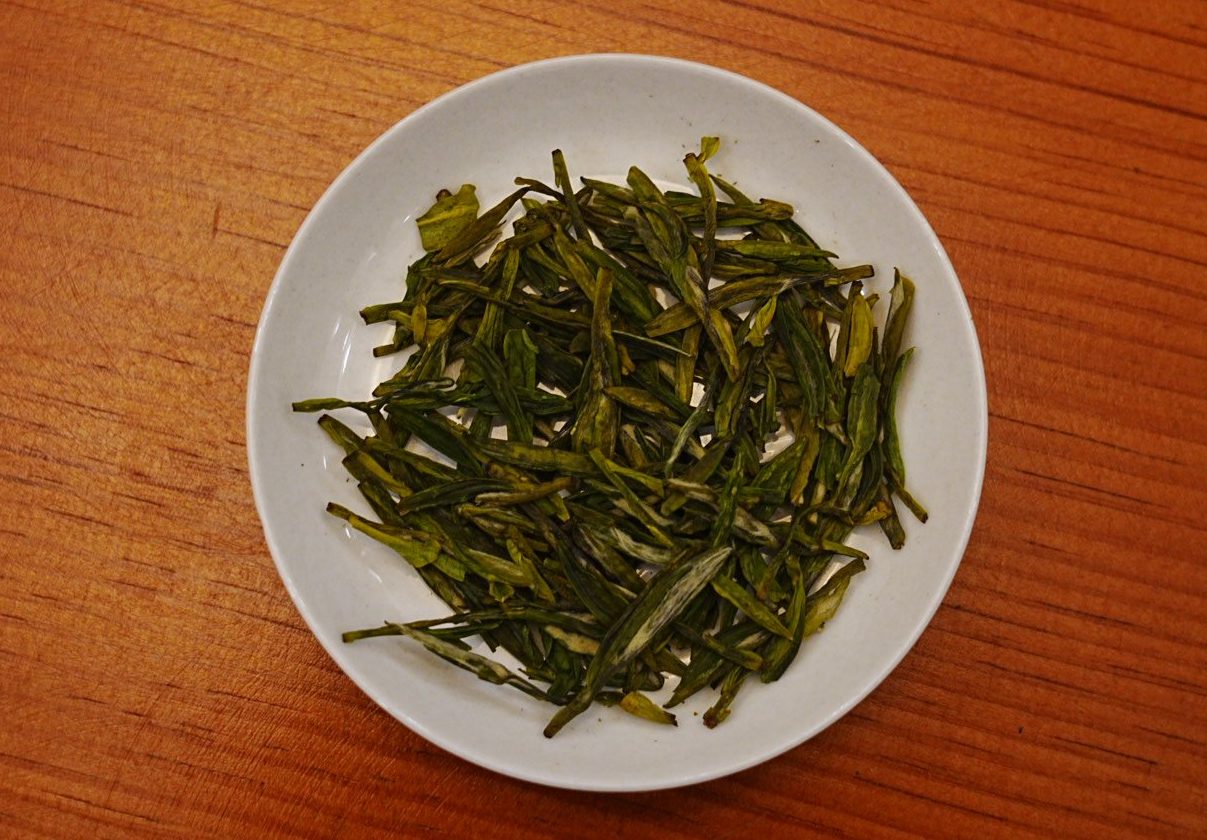
Often celebrated as the “Queen of Green Tea,” West Lake Longjing (West Lake Dragon Well tea) is globally recognized for its unique combination of flat appearance, bright green color, gentle aroma, and sweet flavor. However, within the spectrum of Longjing tea, there exists a hierarchy based on origin, harvest time, and most critically, processing method.
While modern machinery has made Longjing accessible on a mass scale, it cannot replicate the complex artistry of the full handmade method. This article serves as an educational and scientific guide, decoding exactly why full handmade West Lake Longjing is a luxury worth pursuing and how traditional artistry creates a superior sensory profile.
The Crucial Triad of Longjing Quality: Terroir, Harvest, and Artistry
To understand the value of “Full Handmade,” we must first understand the fundamental pillars that define West Lake Longjing:
- Origin and Terroir (地理标志): Authentic West Lake Longjing must come from the designated 168 square kilometer West Lake scenic area in Hangzhou, Zhejiang province. The specific soil composition—high in quartz and phosphorus—and the mist-shrouded environment directly influence the mineral and nutrient content of the tea leaf.
- Harvest Time (采摘时间): The timing of the pluck is paramount.
- Pre-Ming (明前): Harvested before the Qingming Festival (typically early April). These leaves are incredibly tender, high in amino acids (specifically L-theanine), and produce the sweetest, most delicate flavor. This is the most sought-after grade.
- Pre-Rain (雨前): Harvested after Qingming but before Guyu (Grain Rain, late April). The leaves are larger, more flavorful, and slightly more bitter, offering a robust profile preferred by some experienced drinkers.
- Processing Method (加工工艺): This is where the distinction becomes absolute.
- Machine-Made (机制): Leaves are rolled and fried mechanically. This is efficient but applies uniform, blunt pressure that can break cell walls too aggressively and strip away nuance.
- Semi-Handmade (半手工): A hybrid approach, often using machines for the labor-intensive initial drying (Qing Guo) and hands for the final shaping (Hui Guo).
- Full Handmade (全手工): Every single stage, from the initial kill-green to the final polishing, is conducted purely by human hands in a traditional iron wok. It is a vanishing art form that requires decades of apprenticeship.
This article focuses exclusively on the Full Handmade Pre-Ming West Lake Longjing—the rarest combination of these three factors.
Anatomy of Dry Leaves: The First Visual Inspection
Before brewing, a scientific and aesthetic assessment of the dry leaves reveals the first clues to handmade quality.
We have curated three distinct images to guide you through this process. Let us begin with the appearance of the dry leaves.
Visualizing the Classic Shape and Color
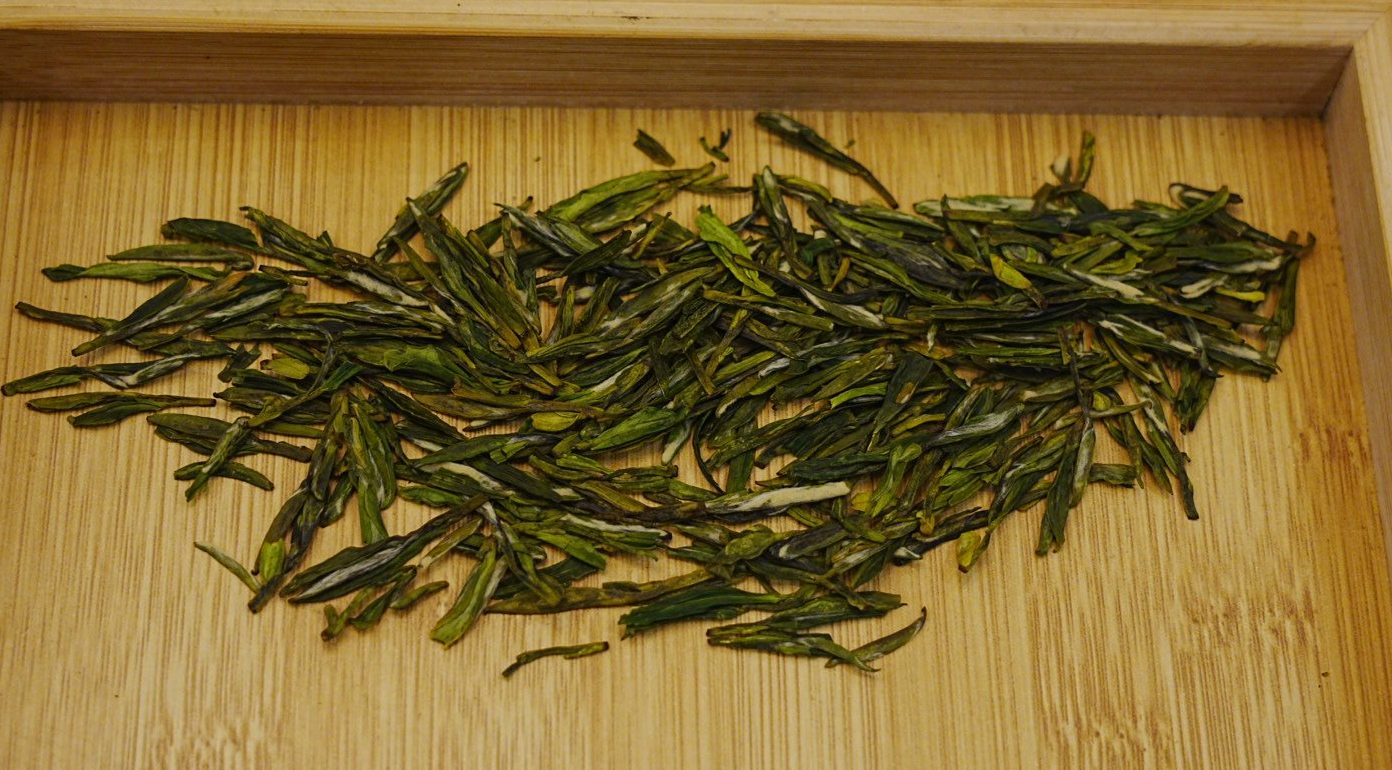
Refer to the image below showing the dry tea leaves spread across a wooden tray.
Image 1: An inspection of the classic Longjing shape. These dry leaves exhibit the ideal flat, straight, and narrow silhouette. Their color is a natural, soft yellowish-green (often referred to as ‘brown rice color’), suggesting an authentic, hand-fired origin. The variation in color within the batch demonstrates the nuance inherent in the full hand-fry process.
When analyzing the dry leaves of full handmade Longjing, focus on these visual markers:
- Flatness (扁平): Unlike most green teas that are rolled into pellets or spirals, Longjing is distinctively flat. This shape is achieved during the Hui Guo (Return Frying) stage, where specific hand movements press the leaves against the surface of the wok.
- Straightness and Uniformity (挺直匀整): A high-quality batch will have leaves of roughly similar length and structure. This uniformity is a direct result of meticulous hand-sorting and the adaptive pressure applied by a master fryer.
- Color (色泽): True West Lake Longjing is not the neon green often associated with other teas. Authentic handmade leaves generally have a soft, natural hue. The most prestigious batches, particularly from Shifeng (Lion Peak), are described as “brown rice color” (糙米色)—a yellowish-green that indicates a higher concentration of certain compounds and a perfectly managed firing process.
Now, consider the leaves in a different light, resting in a porcelain vessel.
Evaluating Texture and Tenderness
Look closely at the leaves in the white porcelain cup.
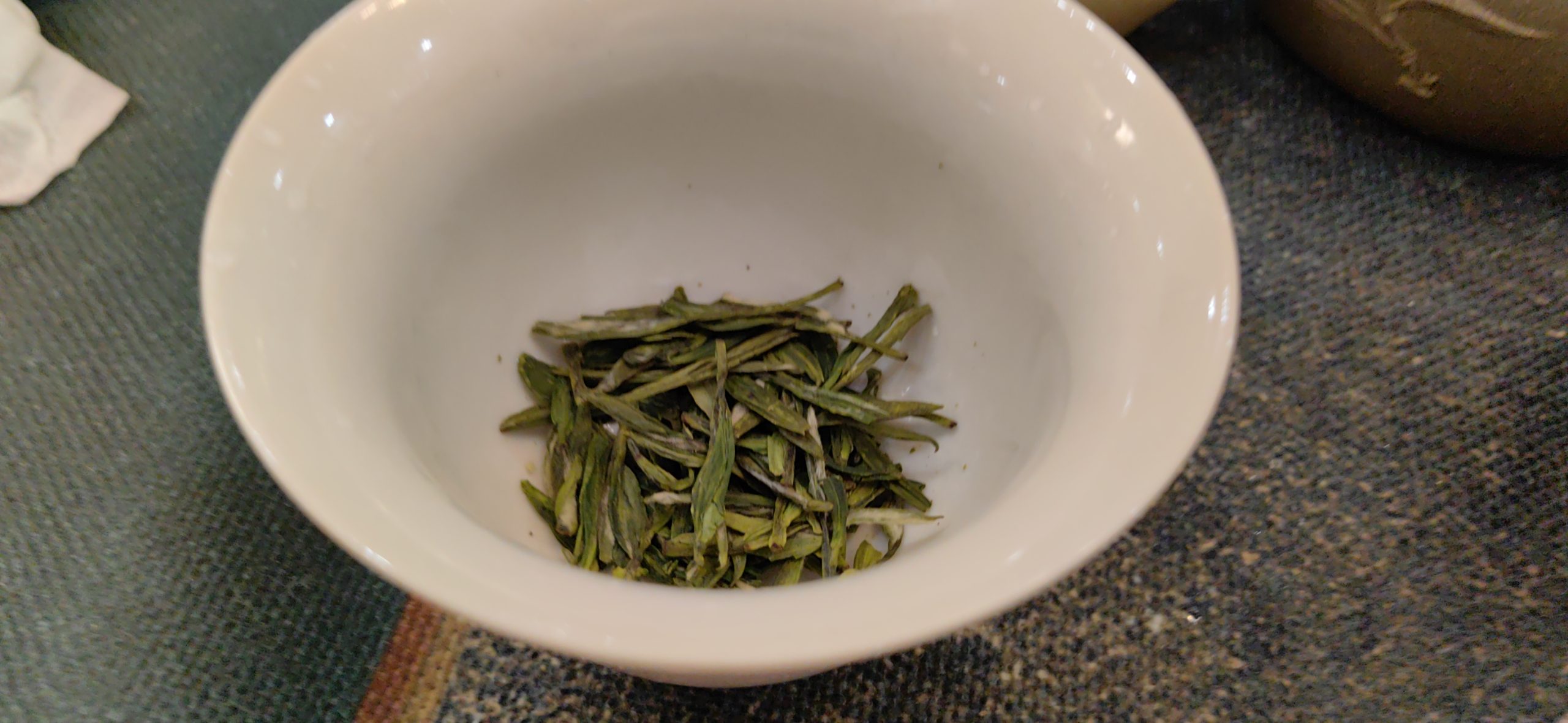
Image 2: Close-up of dry leaves in a porcelain cup. This perspective highlights the texture and delicate nature of the Pre-Ming harvest. The leaves appear incredibly tender and soft, a testament to the early spring picking. The way they rest in the cup speaks to their lightness and minimal cell breakage.
Machine-processing often produces leaves with a gloss that looks “artificial” because excessive mechanical pressure forces oils to the surface. In contrast, full handmade leaves have a more “matte” or natural velvet appearance. Their structure is preserved, not crushed.
The Intricate Art of “Full Handmade” (全手工): A Master’s Ten Techniques
The core reason full handmade Longjing is so revered lies in the wok itself. It is not simply about using hands; it is about the master’s ability to adapt to the inherent properties of that specific day’s harvest—temperature, humidity, and the leaves’ tenderness. Machine frying applies static, uniform pressure. A master, however, listens to the tea.
The traditional process involves two main frying stages in an iron wok, heated typically to around 200°C:
- Qing Guo (青锅): Initial Drying / Kill-Green: This stage lasts 10–12 minutes. Its primary function is twofold: to stop enzymatic oxidation via heat (fixing the flavor) and to remove moisture (down to about 30%).
- Hui Guo (辉锅): Return Frying / Shaping & Polishing: After the Qing Guo, the leaves are spread out to cool and “回潮” (rehydrate slightly) for 1–2 hours. The final stage involves returning them to a lower-temperature wok (80-90°C) to further dry them and define their signature flat shape.
During these stages, the master utilizes The Ten Traditional Hand Movements (龙井十大炒法):
- Grasp (抖)
- Press (搭)
- Jiggle (捺)
- Rub (揉)
- Tussle (甩)
- Squeeze (搨)
- Grind (磨)
- Roll (推)
- Buckle (扣)
- Tuck (压)
A machine can only replicate the most basic “Press” and “Grind” motions. A master uses all ten in a seamless, fluid dance, varying the pressure constantly. When the leaves are too wet, the movements are light and “jiggling” to encourage moisture loss. As they dry and become brittle, the movements transition to “pressing” and “rolling” to achieve the flat shape without breaking the leaves.
Machines are efficient. Master craftsmanship is adaptive. This nuance is impossible to mechanize.
Sensory Analysis: Tasting the Difference
In the world of professional tea cupping, there is a nuanced debate regarding machines versus hands. It is important to acknowledge that a top-tier tea master can indeed use high-end machinery to produce tea that rivals handmade quality. However, the reality of the market is different. For the vast majority of tea farmers, machine processing often leads to several common technical failures that compromise the tea’s soul.
The Pitfalls of Standard Machine Processing
Most machine-processed Longjing found on the market suffers from a lack of “adaptive intuition.” Unlike a master who feels the leaves, a machine follows a rigid program. This leads to two extreme sensory failures:
- Under-Firing and Insufficient “Kill-Green” (杀青不足/口感偏青): When the temperature or pressure is set too low, the enzymes in the leaf are not fully deactivated. This results in a “green” or “grassy” flavor profile. Scientifically, this means a high concentration of residual chlorophyll and unmanaged polyphenols, which manifest as a noticeable astringency (涩味) that coats the tongue rather than melting into sweetness.
- Over-Firing and Excessive Pressure (杀青过度/老火位): Conversely, many farmers over-calibrate the heat or pressure to ensure the leaves are “cooked” and flat. This creates a “heavy” taste, often referred to as “Old Fire” (老火位). While it may produce an intense “bean aroma” (豆香), this aroma is often one-dimensional and “too loud,” masking the delicate floral and orchid notes inherent in the West Lake terroir. The resulting tea loses its characteristic “freshness” and becomes dull.
The Hand-Frying Advantage: Sensory Equilibrium
In contrast, Full Handmade West Lake Longjing is a process of constant, real-time micro-adjustments. Because the master’s hand is in direct contact with the leaves and the 200°C wok, it acts as a biological sensor that machines cannot replicate.
- Adaptive Heat Control: If a master feels the leaves are losing moisture too quickly, they immediately adjust the “Diao” (tossing) height to cool them. This prevents the “scorched” flavor and ensures the tea’s “Inner Fire” is balanced—never raw, never burnt.
- Pressure with “Pulse”: During the shaping stage, the master applies pressure that is firm yet “living.” This specific pressure managed by the human palm ensures the leaf cells are cracked just enough to release the essence without being crushed.
- The Resulting Profile: A handmade brew is defined by its cleanliness and layers. You don’t just taste “beans”; you taste the spring rain, the mineral soil, and a sweetness (Huigan) that is fluid and lively. It achieves a state of “harmony” where no single element—aroma, body, or aftertaste—overpowers the other.
Inspecting the Brewed Leaves: The Final Grade Check
The truest test of quality occurs after brewing. While appearance and flavor are paramount, inspecting the expanded, “living” leaves in the cup offers final scientific proof of grading and processing.
Decoding the Wet Leaves
Refer to the final image, which shows the soaked leaves in a white porcelain vessel.
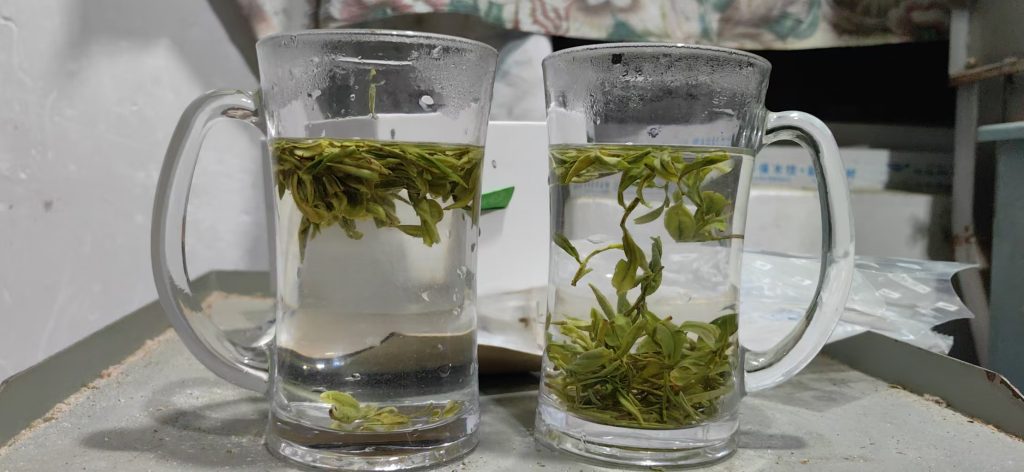
Image 3: Wet leaves inspection. After infusion, the full handmade leaves have unfurled, revealing their detailed structure. Notice how plump, soft, and uniform they are. This image perfectly illustrates the ‘One Bud, One Leaf’ (一芽一叶) or ‘One Bud, Two Leaves’ (一芽二叶) grading typical of Pre-Ming harvests. The leaves are tender (often called “雀舌”—sparrow’s tongue) and intact, demonstrating the gentle managing of the handmade firing process.
When you pour water over high-quality handmade leaves, notice the speed at which they “awake.” While many machine-made teas remain floating on the surface like they have a waterproof coating, handmade leaves begin their “dance” almost immediately, descending gracefully to the bottom.
1. Porosity and “Living” Pressure vs. “Dead” Pressure
The secret lies in the master’s touch. During the frying process, a master applies “living pressure”—a dynamic, intermittent force that shapes the leaf without crushing its internal fiber structure.
- Handmade Structure: This adaptive pressure leaves microscopic pores within the leaf tissue. When hot water is added, these pores act like natural “intake valves,” allowing water to penetrate the core via capillary action almost instantly.
- Machine Structure: Industrial machines often apply “dead pressure”—a constant, heavy mechanical force designed for maximum flatness. This effectively “welds” the leaf layers together, creating a dense, impermeable structure that water struggles to infiltrate.
2. Rapid Air Displacement and Sinking
A tea leaf floats because of trapped air within its cellular compartments. Because handmade tea has a more porous and “breathable” structure, the hot water can displace this internal air much faster. As the air escapes and water fills the voids, the leaf’s specific gravity increases, causing it to sink and stand vertically—a sign of a perfectly balanced, handmade fry.
3. Controlled Cell-Wall Integrity
Look closely at the wet leaves in the image below.
Image 3: Notice the plumpness and elasticity of the wet leaves. In a handmade batch, the master creates “micro-fissures” on the leaf surface that act as entry points for water. This allows the leaf to rehydrate fully and return to its original “living” state, revealing the classic ‘one bud, one leaf’ or ‘one bud, two leaves’ structure with incredible clarity.
The Scientific Profile: Health Benefits and Chemistry
Beyond artistry and flavor, West Lake Longjing is a powerhouse of health-promoting compounds. The gentle hand-fry process does a superior job of preserving these delicate molecules compared to harsh industrial heat.
Key biochemical components of Full Handmade Pre-Ming West Lake Longjing include:
1. L-Theanine
This unique amino acid is the primary driver of the “umami” flavor and the lingering sweetness. It is also famous for its ability to promote relaxation and mental clarity by increasing alpha brain waves, acting as a natural anti-anxiety agent.
- Why Pre-Ming is Higher: Because the leaves grow slowly in the cool early spring, they accumulate high levels of L-theanine. Full hand-firing gently seals in this compound.
2. Tea Polyphenols (Tea Tannins)
This is a group of powerful antioxidants, primarily catechins (e.g., EGCG). They have been scientifically linked to a range of benefits, including anti-inflammatory properties, improved cardiovascular health, and potent metabolism support (weight management).
- Science of Hand-Frying: A master’s gentle touch preserves these compounds in their natural state. Machines often cause excessive physical cell breakage, releasing tannins too quickly into the water, resulting in bitterness. Handmade leaves offer a smooth, managed release of flavor.
3. Caffeine
While Longjing contains caffeine for a mild energy boost, the synergistic effect of the high L-theanine content helps smooth out the jittery edge often associated with coffee.
How to Properly Brew Full Handmade West Lake Longjing
To appreciate the full potential of this exceptional tea, you must not mistreat it. While robust, its nuance can be ruined by improper brewing.
- Water Quality: Use filtered or spring water. Hangzhou’s Hupao Spring water is legendary for its synergy with Longjing, as it is mineral-rich yet soft.
- Water Temperature: Boiling water is not suggested, which will “scorch” the tender leaves, releasing bitterness and destroying flavor. The ideal range is 80°C – 85°C.
- Vessel: A clear glass is ideal to witness the “dance” of the leaves. High-quality leaves will slowly sink to the bottom, standing vertically. A traditional white porcelain Gaiwan is also excellent for concentrating aroma and flavor, allowing for multiple infusions.
- Rinsing: Unlike many teas, high-quality Pre-Ming green teas do not require a “rinse.” The first infusion is often the most aromatic.
- Steeping Time: The first infusion should be short, perhaps 15-25 seconds. Subsequent infusions can be extended slightly. Expect at least 3-4 excellent infusions from a single dose of high-grade, full handmade leaves.
Frequently Asked Questions (FAQ)
1. Why is Full Handmade West Lake Longjing tea so expensive?
The premium price of Full Handmade West Lake Longjing is a reflection of three critical factors: Scarcity, Labor, and Heritage.
- Extreme Scarcity: Authentic West Lake Longjing is harvested from a strictly protected 168 $km^2$ region. Within this, the “Full Handmade” batches represent less than 5% of total production.
- Labor Intensity: A master fryer can only produce approximately 500g of finished tea per day. This requires 10+ hours of standing over a 200°C iron wok, executing the “Ten Traditional Hand Movements” with absolute precision.
- Production Cost: It takes roughly 40,000 to 50,000 tender hand-picked buds to produce just 500g of Pre-Ming tea. When you combine the harvest cost with the master’s artisanal fee, the price reflects a “luxury of time and effort” that machines simply cannot match.
2. How can I tell if my Longjing is authentic and truly handmade?
Identifying authentic handmade West Lake Longjing involves a sensory audit of the “Four Perfections”:
- Color (The “Brown Rice” Hue): Authentic handmade leaves are not neon green; they possess a soft, yellowish-green hue known as “Brown Rice Color” (糙米色).
- Shape: Look for leaves that are flat and smooth but show slight, natural irregularities. Machine-made leaves often look “too perfect” or artificially glossy.
- Fragrance: Handmade tea has a deep, integrated “bean” or “chestnut” aroma that lingers. If the scent is sharp but disappears quickly, it may be low-grade or machine-processed.
- The Aftertaste (Huigan): Real handmade Longjing must produce a distinct, sweet cooling sensation in the throat (回甘) after the first few sips.
3. What is the difference between Pre-Ming (Mingqian) and Pre-Rain (Yuqian) Longjing?
This is the most common question regarding harvest timing:
- Pre-Ming (Mingqian): Harvested before the Qingming Festival (early April). These are the “First Growth” buds, extremely high in L-theanine (amino acids) and low in catechins. The result is an incredibly sweet, mellow flavor with zero bitterness.
- Pre-Rain (Yuqian): Harvested later in April. The leaves are larger and the plant has grown faster due to warmer weather. While less “tender,” Yuqian Longjing has a more robust, “stronger” tea flavor and is generally more affordable, making it a favorite for daily drinking.
4. What is the best water temperature and method for brewing Handmade Longjing?
To avoid scorching the delicate antioxidants and amino acids, follow these professional parameters:
- Temperature: Never use boiling water. The ideal range is 80°C – 85°C (176°F – 185°F).
- Vessel: Use a tall, clear glass (to observe the “dance of the leaves”) or a white porcelain Gaiwan.
- The “Top-Drop” Method: For the highest quality handmade leaves, fill the glass 70% with water first, then drop the leaves in. This allows them to sink slowly and prevents “bruising” the buds with a heavy water stream.
- No Rinse Required: High-grade Pre-Ming Longjing is clean and the first infusion contains the highest concentration of nutrients; do not wash it away.
5. How should I store high-grade Longjing to preserve its fresh “Spring” aroma?
Green tea is unoxidized and highly volatile. To keep your handmade Longjing fresh for up to a year:
- Airtight & Opaque: Use a tin or ceramic canister that blocks all light and air.
- Refrigeration is Key: For long-term storage (over 1 month), keep the sealed container in a refrigerator at 0°C – 5°C.
- Avoid Odors: Tea leaves are highly absorbent. Ensure the tea is double-sealed to prevent it from picking up scents from other foods in the fridge.
- Temperature Acclimation: When taking it out to brew, let the container reach room temperature before opening to prevent moisture condensation on the cold leaves.
Conclusion: The Value of Tradition in a Modern World
In an era of rapid mechanization, Full Handmade West Lake Longjing stands as a magnificent outlier—a tangible connection to a continuous art form spanning over a thousand years.
When you purchase a batch of true full handmade tea, you are not just buying leaves. You are acquiring the decade-spanning skill of a master artisan. You are securing a product defined by its unparalleled smooth flavor, its complex aroma, and its high concentrations of beneficial amino acids and antioxidants, perfectly managed and sealed by human touch.
It is a vanishing, labor-intensive craft. Yet, the existence of this tea proves that some experiences—the perfect synergy of terroir, timing, and human artistry—simply cannot be mechanized. For the true tea connoisseur, there is no substitute.